Six ways to increase confidence in elections

President-elect Donald Trump lost the election in 2020 and won in 2024. Both election nights, though, brought the same sense of uneasiness to many Trump supporters. It wasn’t about the anticipation of who would be the victor, although each election was quite exciting. Election night is our Super Bowl of politics.    

Rather, it was wondering if the election results would be fair, honest, and accurate.

There’s reason for concern.

At a Bucks County, Pennsylvania, Board of Elections meeting, Democratic Commissioner, Diane Ellis-Marseglia, blatantly—and without fear of consequences—stated that she would not adhere to state election laws and intended to count unlawful votes.  

The Republican National Committee immediately responded. Having deployed 100,000 volunteers and attorneys across battleground states, it was ready for any shenanigans. It sometimes takes the threat of legal action to ensure a fair, honest, and accurate vote. That’s where we’re at.

In the future, there may be weariness in fighting so hard for the truth. We may not always have the fortitude to bring in thousands of lawyers during election season just to protect the vote.

There must be a better way.

Voters do not have confidence in the election process. According to a 2024 Gallup poll, only 28% of Republicans have faith in the accuracy of the vote.

Trump will have many fires to put out when he takes office in January—reducing inflation, securing the border, and de-escalating tensions around the globe and averting another world war.

But election integrity reforms need to be a high priority, as well.

There are six ways we can restore voter confidence in our elections.

  1. Prosecute election officials who knowingly tamper with election results. It takes many good people to run an election. The vast majority are honest, and the system keeps them that way because at least one Democrat and Republican election official work together at the precinct level. And nobody wants to start punishing these individuals if an honest mistake is made. It’s hard enough to find people to fill these positions. But when interfering with elections is conclusively proven to be willful, legal action must be taken. There may be progressive Democrats and “Never Trumper” Republicans who think they’re saving democracy by distorting the vote. But their idea of saving democracy may not be as much fun if they know they will be publicly prosecuted for their misdeeds.
  2. Make Election Day a national holiday. It’s become that important. Give citizens every opportunity and no excuse to get to the polls on Election Day.
  3. Make absentee voting a rare occurrence. We will always have a need for some type of exceptions to voting in person on Election Day. Military serving overseas, those traveling on Election Day, the homebound and institutionalized, and essential workers—those working in the health care field or certain service industries who must still report to work on Election Day—must be given the opportunity to vote by absentee ballot. But keep the window to only four full weeks prior to the election. That’s more than enough time for these individuals to either vote in person at the county auditor’s office or to request a ballot by mail, receive it, vote, and return by mail so that it is received by Election Day. For everyone else, the expectation is to vote in person on Election Day—especially if the day becomes a national holiday.
  4. Use paper ballots that are hand-counted. According to TDMS Research, other major democracies—such as Germany, Norway, Netherlands, France, Canada, Denmark, Italy, United Kingdom, Ireland, Spain, Portugal, Sweden, and Finland—hand-count paper ballots in a publicly observable way. It’s not surprising that these countries have a far higher confidence in the honesty of their elections.
  5. Require precinct election officials to post unofficial vote counts on the state’s Secretary of State website before leaving the precinct. After ballots are delivered to the county auditor, require the county auditor to submit confirmed and official vote counts by precinct to the Secretary of State website in a timely manner. Also, submit county data for the absentee ballot results. Maintain these three data sets online. Store county absentee ballots and precinct ballots separately, in the event a recount is needed.  
  6. Lastly, to state the obvious, only adult citizens providing voter identification can be allowed to choose our governing leaders.

Prosecute bad actors, make Election Day a national holiday, make absentee voting a rare occurrence, use paper ballots only, post results immediately, and keep non-citizens from voting.

By doing this, election night will continue to be exciting without that sense of uneasiness.

We’re a bit of a sports-crazed nation, and so we understand that sometimes our team wins and sometimes it loses. We just want a fair competition.

Then—just like sports enthusiasts—voters can accept the results more easily and move forward.

Climate change elitists and their plans for us

Turning 50 years old felt no different than turning 40. This aging thing was a piece of cake.

Then 60 happened.

The day was commemorated with an enjoyable celebration with family and friends.

But the next day brought sore feet and a slight pain in my lower back. Being 60 years old does not feel the same as being 50. Although I’m currently in relatively good health, my body is telling me what its future plans are for me. Physically, I’m beginning the great, gradual decline.

Steve Magness, author of, “Do Hard Things,” tells us, “When we name something, we exert power and control over it. We are saying, ‘I know what you are and how to handle you.’”

Aging, I know you’re here and what I must do. Although I’ve been mindful over the years to enjoy life the best I can, I will strive even harder now to live to the fullest.

Naming something gives it immediate attention and is the first step toward correcting course. Too often, dealing with reality is something we choose to put off or not think about.

It happens in politics, too.

Climate change elitists are telling the average American what they’re going to do to us. Just a few years ago, some of these ideas were considered laughable. We didn’t spend too much time thinking about it. We didn’t name it.

And now, because these green rulers have infiltrated influential, non-governmental organizations, state governments, and the Biden administration, some of these ridiculous notions are being seriously considered.

The World Economic Forum is touting the benefits of eating insects. Crickets, it states, are dense in protein and calories. Production of cricket protein uses fewer resources of land, water, transportation fuel, and human labor. It is estimated that we’ll have 10 billion people on the planet by 2050 and that eating insects could be a good source of protein for many.

However, climate change elitists won’t be letting cows go extinct. They’ll save those T-bone steaks for themselves. For the rest of us—crickets.

I’d rather have a T-bone. Or at least, a juicy cheeseburger.

The push for electric vehicles is outpacing the production of charging stations throughout the country. Efficiency in charging just isn’t there yet, either. An electric vehicle might get us about 200 miles down the road before we have to pull over and charge the battery for an hour. And that’s best-case scenario. You may have to first wait in line before you can wait for your vehicle to charge. These challenges haven’t stopped California from requiring all new vehicles sold in its state to be electric by 2035.

That’s not mobility freedom. That’s a leash.

Meanwhile, the green royal class won’t be giving up their private jets. They have important things to do. Like figure out how to stop the common people from using too many resources.

And our homes will be subjected to all kinds of regulations. Government intrusions will dictate which appliances we can buy and use. If there’s one thing the Biden administration is prolific at, it’s relentlessly pushing its green agenda right through our front door.

Home ownership will start to feel more like playing house.

But climate change elitists, living in mansions, will have access to on-demand energy resources.

Food. Transportation. Our homes. They’re telling us what they’re going to do to us.

We’ll be allowed to exist. Sort of like pets.

But they’ll tell us what we can eat, where we can go, and what we can own.

Most of us do desire to protect the environment, but the approach must be reasonable and fair to all.

A society composed of royalty and its subjects is something we did away with in 1776. Nobody misses it.

Except elitists. If they’re successful with this clever form of class warfare, the country could experience a great, gradual decline.

But there’s still time to make a course correction.

Name it, vocally push back on it, and vote this type of thinking out of office.

Be like Clete and the boys

There’s a photo collage that draws me in every time I see it.

It’s of my Uncle Clete and his three boys. All are in military uniform. Each in a different one.

Clete, now passed, served in the Air Force. Jim served in the Navy and now lives in Michigan. Darrell was a Marine and resides in Virginia. Bob served in the Army Reserves and now calls Indiana his home.   

Many branches, but one mission—to love and defend our nation.

Some families have a proud tradition of generations joining the same branch of the military and serving. That is so good.

But I love the “same, but different” message that emanates from this photo. All loved their country and served, but each was independent-minded enough to go his own way.

It provides the first teachable moment—think for yourself.

The election season is upon us. No one political party has all the answers. Or, maybe a better way to say it is that political parties try to have too many answers. Very few would be willing to sign their name to all that their party professes on its state platform. The 2022 Iowa Democratic Party Platform has 560 statements of support or opposition to particular issues. That’s a lot of red lines. Republicans are capable of churning out quite a few planks too.

If the average Iowa voter isn’t going to be in full agreement on these hundreds of items, it makes extreme party loyalty unnecessary. Instead, consider what’s most important this election cycle and then determine which candidate is best suited to deliver.

Think. And then vote for individuals who can also think for themselves.    

The collage of Clete and the boys are typical basic training photos. They show confidence and determination. They didn’t have their whole life planned out at the moment. They didn’t need to. All they had to do was the next, right thing. And the next. And the next.

It’s not always easy to do the next, right thing. That’s called courage.

Most have moderate political voices. It can be a little overwhelming to simply hang on to that voice when louder voices attempt to silence it.  But take on cancel culture anyway, and don’t give up on finding reasonable, common-sense solutions to needs. Do it today and the next. And the next.

Have courage. Vote for others who have courage.

Lastly, remember that we’re on the same team.

I put three kids through school who were all active in high school sports. We didn’t always win. On nights when we were getting clobbered, though, I would look at the opposing team and think about how at least some of these kids would likely go on to join the military. Then, they would be on my team. Team USA.

The world seems to spin out of control when the United States doesn’t show leadership or display economic and military strength. Our team needs to win.

Always.

Vote for the candidate who will put our country first.  

This election, Clete and the boys don’t expect us to don uniforms in order to love and defend our nation. But let us think for ourselves, be courageous with our beliefs, and put our country first.

And vote for people like that too.

Vote for Trump, despite race, gender and peer pressure

Image by Shutterstock.

There are Trump voters, Biden voters, and undecided voters.

There’s a fourth group of voters, though. They’re people who actually agree with the policies of President Donald Trump but are abandoning their vote for him.  

Race, gender and pressure from family and friends are probably the three biggest reasons why a vote doesn’t match a belief system.

It doesn’t have to be that way.

The Pew Research Center conducted a survey of validated voters from the 2016 election. It reported that 91% of Blacks, who cast a vote, did so for Hillary Clinton. That election was not unusual. The Center found that in the last 40 years, Black voters have solidly supported Democratic contenders.

Presidential candidate, Joe Biden, may believe it’s “a given” that he’ll receive the Black vote. He stated, “If you have a problem figuring out whether you’re for me or Trump then you ain’t Black.”

Nothing could be more racist than to tell someone that it’s not necessary to do your own thinking.

Since 2016, Black unemployment fell and wages increased. Criminal justice reform became real with The First Step Act. And Opportunity Zones made entrepreneurship more possible for Black Americans. This all happened under the first three years of the Trump administration, before a global pandemic hit.

The Center also found in a recent poll that only 39% of women voters favor the president’s re-election.   

Some have called Trump a misogynist because of past words and actions.  

But there’s plenty of video of Biden and his many inappropriate actions with women. And then there’s the sexual assault allegation by a former aide.

Neither one is a saint.

But during the Trump presidency, female unemployment fell and wages increased. The Tax Cuts and Jobs Act increased the child care tax credit. And safety is on the ballot, this year. Trump has received many law enforcement endorsements. Biden never condemned the violence, burning and looting happening in predominately Democratic-run cities, during his own national convention.  

Besides race and gender, there’s the pressure factor from friends and family who value personality over policy.

Although this president has given us too many testy tweets and not enough lofty oratory, he did something more important.

He brought back our nation’s confidence.

We are an exceptional nation, and we don’t need to apologize for it.   

He fortified a military that was becoming vulnerable. Peace is only possible through strength.  

Trump went to work immediately on correcting huge trade deficits with China, Mexico, Canada, and others that hurt the American worker, while other corrupt players became filthy rich. The swamp hates Trump.   

United States taxpayers are no longer expected to foot every bill from every world organization, while other nations don’t do their fair share.

The small business optimism index reached record highs under the Trump administration, because of his regulation-slashing and tax-cutting measures. When small businesses are optimistic, they hire more, pay more, and invest more in their businesses.

And if 401k growth is your thing, consider that the stock market fell when Trump entered the hospital for COVID-19 and rose when he was released. The economy likes Trump.

In the book, “The Help,” 1960’s Black maid, Aibileen, talks with her friend, Minny, about the imaginary lines in our lives—whether it’s about racism or domestic abuse. “I used to believe in em. I don’t anymore. They in our heads…Lot a folks think if you talk back to you husband, you crossed the line. And that justifies punishment. You believe in that line?…Cause that line ain’t there. Except in Leroy’s head. Lines between black and white ain’t there neither. Some folks just made those up, long time ago…You don’t have to get hit by Leroy no more…You are free.”

Plenty of people lay down lines for voting, too.

Maybe nobody has reminded you of this in a long while, but you are free.

Free to vote according to your belief system.  

It’s not the race vote, the gender vote, the household vote, the friend circle vote, or family tree vote.

It’s one person—one vote. Yours.

Study each party’s platform. Make a choice. And don’t let any imaginary lines get in your way.  

More respect is needed for election outcomes

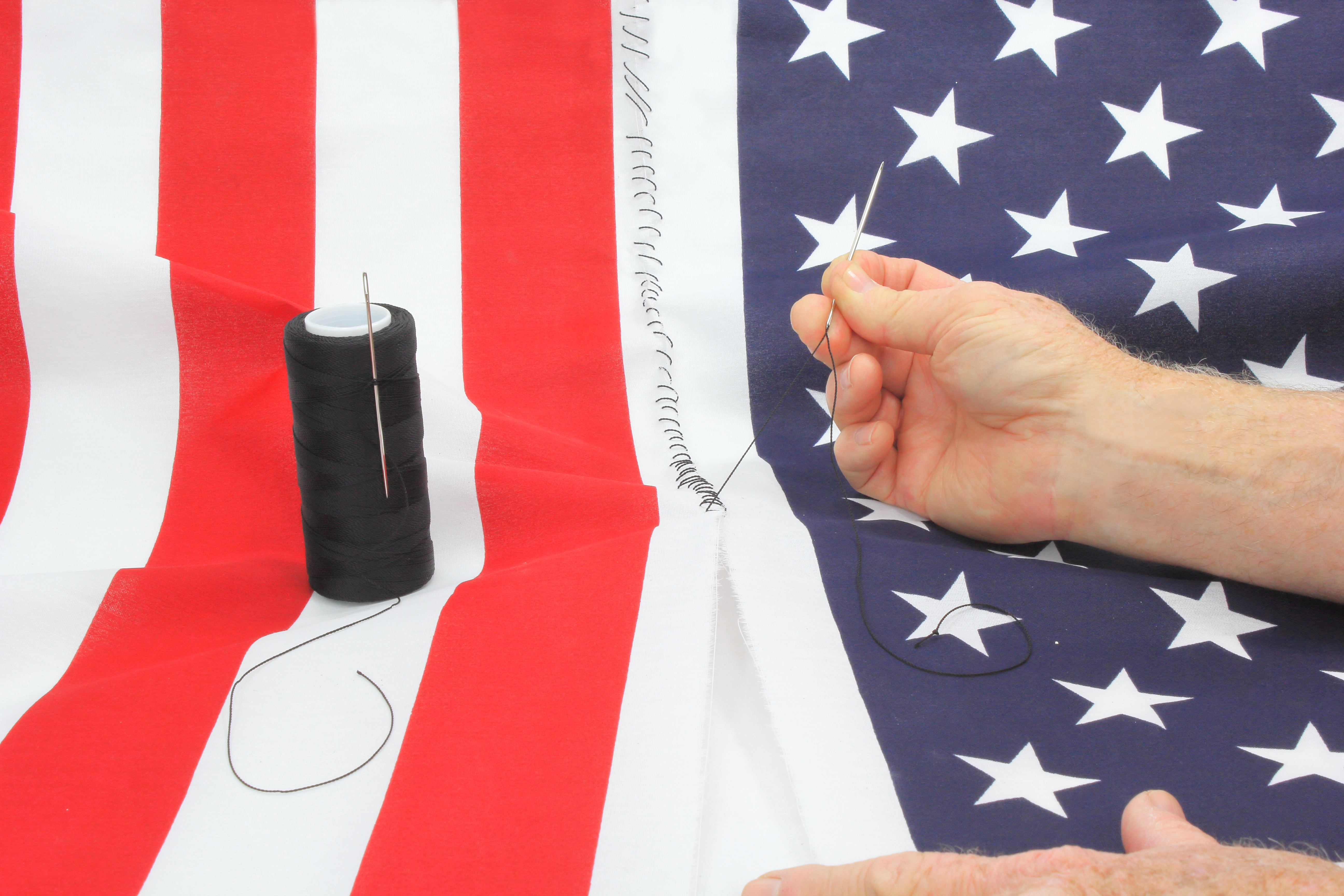
flag repair

Image by Shutterstock.

There’s no crying over elections.

Or there shouldn’t be. It’s disrespectful to the voters who placed a particular candidate in office.

First, we had protesters and resisters over the legitimate election of President Donald Trump in 2016. Being disappointed that your candidate doesn’t win is understandable. But disrespecting the vote from those who put him in office becomes divisive.

Now, we’re seeing that same mentality creating divisiveness from the midterm elections.

Georgia candidate, Democrat Stacey Abrams, lost the governor’s race to Republican Brian Kemp by about 50,000 votes. Abrams had the support of 1,923,582 voters. That’s a lot.

But 1,978,383 Georgians voted for her opponent. That’s a little more and enough to secure the win. These facts—and people—can’t be ignored, but she still disrespected all Kemp voters when she said, “Let’s be clear: This is not a speech of concession.”

Abrams has claimed possible fraud, but evidence of it has not been produced. What she does have are certified election results—results showing that nearly 2 million Georgians voted for her opponent. It may be tough for her to acknowledge, but a thin win for Kemp is still a win.

Republican candidate for U.S. Senate, Martha McSally, also lost her election by about 50,000 votes. She lost the Arizona seat to Democrat Kyrsten Sinema. Surely, McSally would have liked to focus on the support she received from 1,059,124 voters. But it would have been disrespectful of the 1,097,321 Arizona citizens who voted for her opponent. She graciously conceded the race by saying, “I wish her all success as she represents Arizona in the Senate.”

McSally understands that we’re not entitled to much, but in this country we’re still entitled to vote for the candidate of our choice. And that vote must be respected.

Losing a hard-fought election by just 50,000 votes when 2 million or 4 million are cast must be gut-wrenching. It doesn’t have to be divisive, though.

Divisiveness happens when there’s a refusal to accept that others have the right to form political opinions and vote in a way that doesn’t match your own. It isn’t what we do. It’s what we not allow others to do.

Without this considerate understanding, family and friends can morph into “deplorables” or “leftists” instead of just citizens doing their best for country and family.

And when things don’t go our way, there’s always another opportunity in two, four or six years to try again. Voters don’t always get it right, but they’re pretty good at making adjustments and corrections. Midterms are notorious for that. But in some ways, every election comes down to answering one central question, “Is an adjustment needed?”

Abrams and McSally have proven they are viable candidates with strong support. They are certainly worthy of trying again in their next election cycle, if it’s what they desire. Showing respect for the vote and all voters—whether they were for you or against you—would be a great place to start.

In the last presidential election, my three adult children all voted for a different candidate. Surprisingly, it created a sense of contentment for this fiscal conservative. They think for themselves. It’s what should be expected and then respected of every voter.

Advocate your beliefs without dismissing someone else’s. Exercise your right to vote without disrespecting the vote of others.

You will win some. You will lose some.

Nothing, at all, to cry about there.

Path to voting for felons is reasonable

The debate over disenfranchised felons misses the mark. There’s a lot of indignation about lost voting rights, but it’s really a story about the lack of transparency and lack of desire.

felon voting

Image by Shutterstock.

Democrats and Republicans have made the issue a political football. Most Democrats assert that voting is a right—not a privilege—that should be restored immediately after being released from prison. Its belief system is helped out by the fact that many felons are low-income individuals who tend to vote Democrat. Many Republicans view voting as a privilege belonging to law-abiding citizens. The notion is that by choosing to commit a felony, an individual makes a simultaneous choice to lose voting rights. Those rights can be restored after release from prison by completing an application process, but some believe these potential Democrat voters may not go through that effort.

Both political parties want control of the vote, but what does the average, newly-released felon want?

There are dozens of agencies, charitable organizations and ministries designed to help a felon reenter society. Some help with basic needs of food, clothing and housing. Others help with employment opportunities and everything that goes along with getting that first job, like obtaining a new driver’s license.

What’s been getting missed, is the conversation about how to restore voting rights. As soon as the prison doors swing open, the Iowa Department of Corrections should be required to notify all released felons of the process required to restore voting rights and offer assistance if needed.

The tragedy isn’t that voting rights were taken away because of the crime committed. It’s that the process to restore those rights isn’t transparent.

It’s the spark that eventually led to the current Griffin v. Pate firestorm. Kelli Jo Griffin, a convicted felon, didn’t know about the, “Application for Restoration of Citizenship Rights.” She thought her voting rights would be automatically restored after her debt to society was paid. Better communication might have helped to avoid the lawsuit that is being argued before the Iowa Supreme Court.

It shouldn’t be a secret on how to be a voter in Iowa. Understanding how to restore voting rights should be as common as knowing how to get your driver’s license back after it has expired. Most people know that once a license is expired, an individual must spend a fair amount of time and effort to restore driving privileges. One must pass a written and driving test, and provide supporting documentation of identification. People know the rules. And if it does expire—for anyone, felon or non-felon—individuals will exert the effort needed. Because driving is important to them.

The U.S. Department of Transportation states that about 87 percent of the driving-age population has a license. Compare that percentage with the 42 percent of individuals who, according to the U.S. Census Bureau, exercised their right to vote in the 2014 elections.

Citizens in this country care about voting about half as much as they care about driving.

Transparency is the first tool to combat the disenfranchising of felons. Information on how to restore voting rights should be made available at the time of release and assistance provided if needed.

Then comes the tougher part—desire. In the state of Iowa, it takes desire on the part of the felon to become a voting citizen again by making the effort to pay restitution, complete the application process, and provide supporting documentation. The newly-streamlined application has 13 questions. They’re basic, fact-based questions like name, address and date of birth, as well as date of crime, conviction and release.

I believe in second chances. Kelli Jo Griffin does too. She’s part of the 42 percent who want to vote.

Armed with knowledge and effort, her goal could have been met a long time ago.